|
Xikai Sun (孙熙凯) I'm a Phd student at Department of Automation, Tsinghua University, in Beijing. I received my bachelor degree from Department of Automation, Tsinghua University in 2023 and went directly to pursue my doctoral degree. I am very fortunate to be supervisored by CAS Academician Yunhao Liu. My research interest includes Emboddied AI, AI for Nertork and AIoT. |

|
ResearchI'm interested in Emboddied AI, AI for Nertork and AIoT. I am dedicated to integrating Internet of Things (IoT) technologies into embodied intelligence systems to achieve Embodied Intelligent of Things(EIOT). |
|
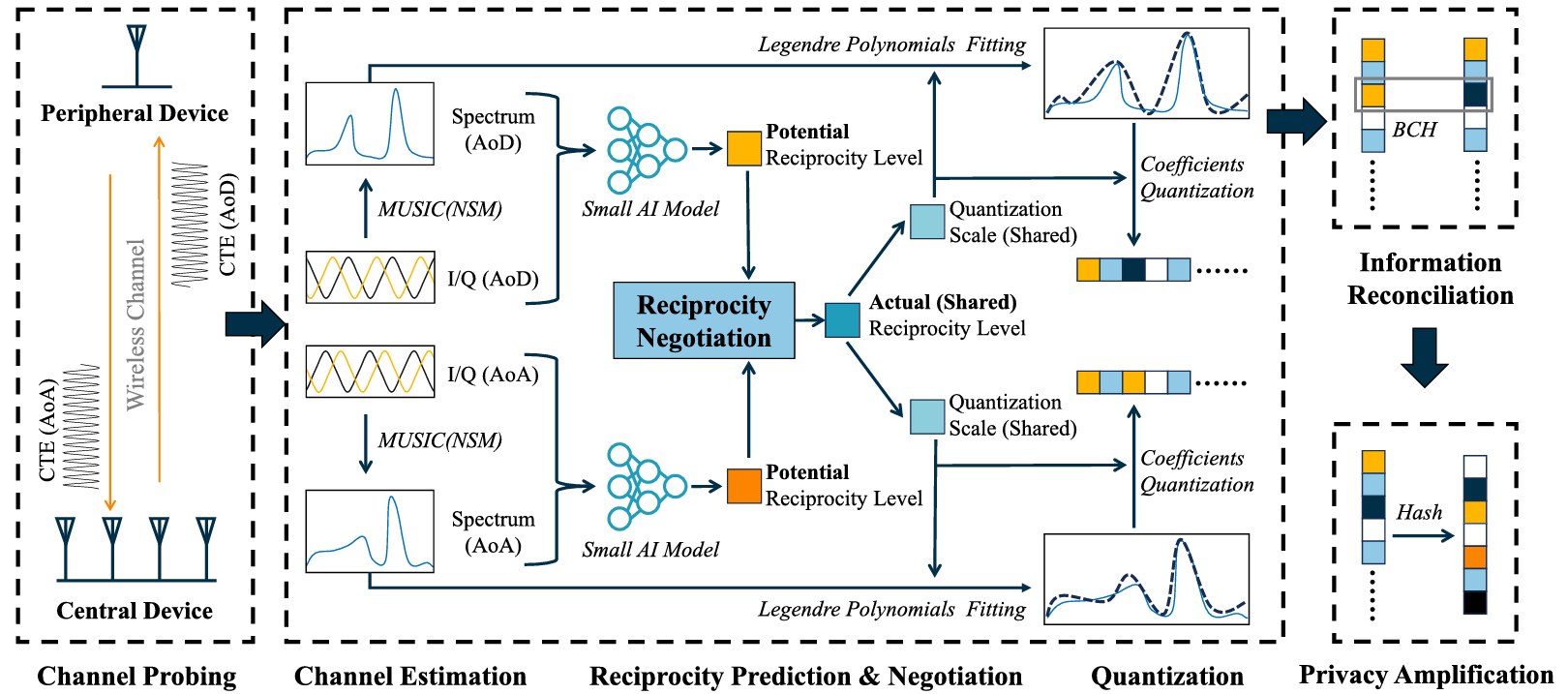
Hinge: An Environment-Varying Adaptive Physical-Layer Key Generation Scheme
Zihao Yang, Lin Wang, Yawen Zheng, Fan Dang, Xikai Sun, Zijuan Liu, Yunhao Liu TIFS, 2025 [CCF A] journal paper / bibtex Abstract: On low-power, low-cost Internet of Things (IoT) edges, coarse-grained entropy source-based physical-layer key generation (PKG) is often used, which results in a very low bit generation rate (BGR). In this paper, a novel PKG scheme, Hinge, designed to adapt to varying environmental conditions is introduced to optimize the trade-off between the bit mismatch rate (BMR) and BGR using fine-grained entropy sources on IoT devices. Hinge predicts channel reciprocity levels from one side and dynamically adjusts the quantization strategy, maintaining a low BMR while maximizing BGR. Compared with existing PKG solutions on Bluetooth devices, Hinge yields significant improvements in BGR, with a comparable BMR. Through extensive experiments, Hinge showcases its potential for providing a secure and efficient key generation mechanism for IoT devices in complex real-world scenarios. |
|
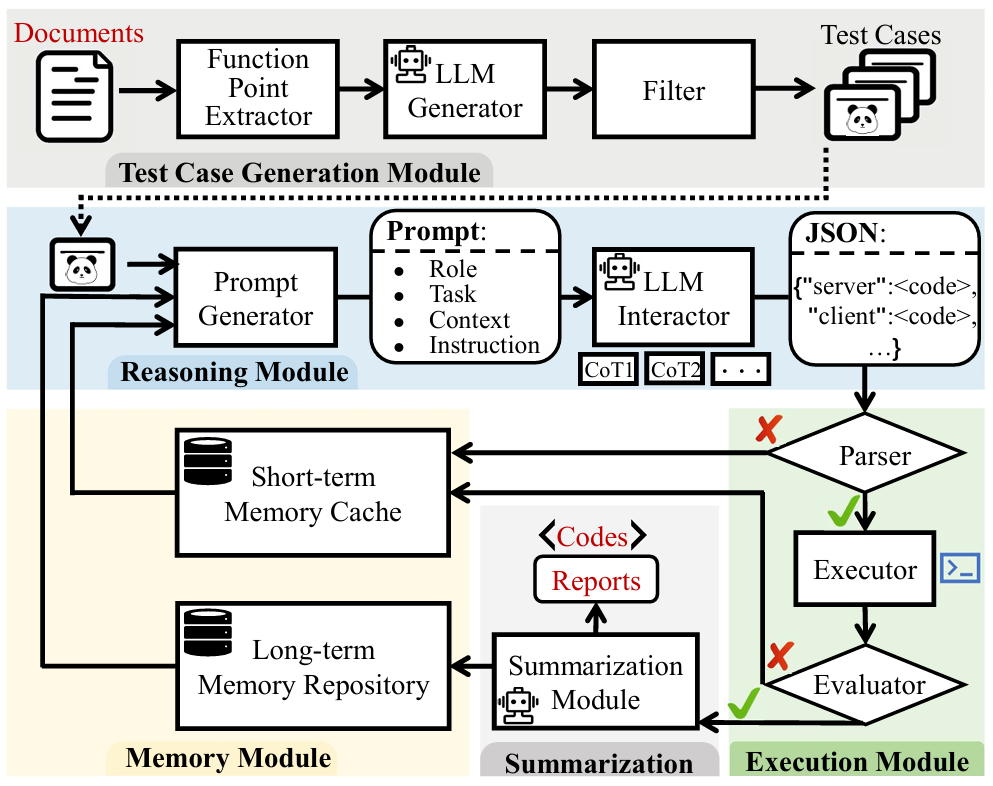
iPanda: An LLM-based Agent for Automated Conformance Testing of Communication Protocols
Xikai Sun, Fan Dang, Shiqi Jiang, Jingao Xu, Kebin Liu, Xin Miao, Zihao Yang, Weichen Zhang, Haimo Lu, Yawen Zheng, Yunhao Liu arXiv, 2025 arXiv paper / bibtex Abstract: Conformance testing is essential for ensuring that protocol implementations comply with their specifications. However, traditional testing approaches involve manually creating numerous test cases and scripts, making the process labor-intensive and inefficient. Recently, Large Language Models (LLMs) have demonstrated impressive text comprehension and code generation abilities, providing promising opportunities for automation. In this paper, we propose iPanda, the first framework that leverages LLMs to automate protocol conformance testing. Given a protocol specification document and its implementation, iPanda first employs a keyword-based method to automatically generate comprehensive test cases. Then, it utilizes retrieval-augmented generation and customized CoT strategy to effectively interpret the implementation and produce executable test programs. To further enhance programs' quality, iPanda incorporates an iterative optimization mechanism to refine generated test scripts interactively. Finally, by executing and analyzing the generated tests, iPanda systematically verifies compliance between implementations and protocol specifications. Comprehensive experiments on various protocols show that iPanda significantly outperforms pure LLM-based approaches, improving the success rate (Pass@1) of test-program generation by factors ranging from 4.675 times to 10.751 times. |
|
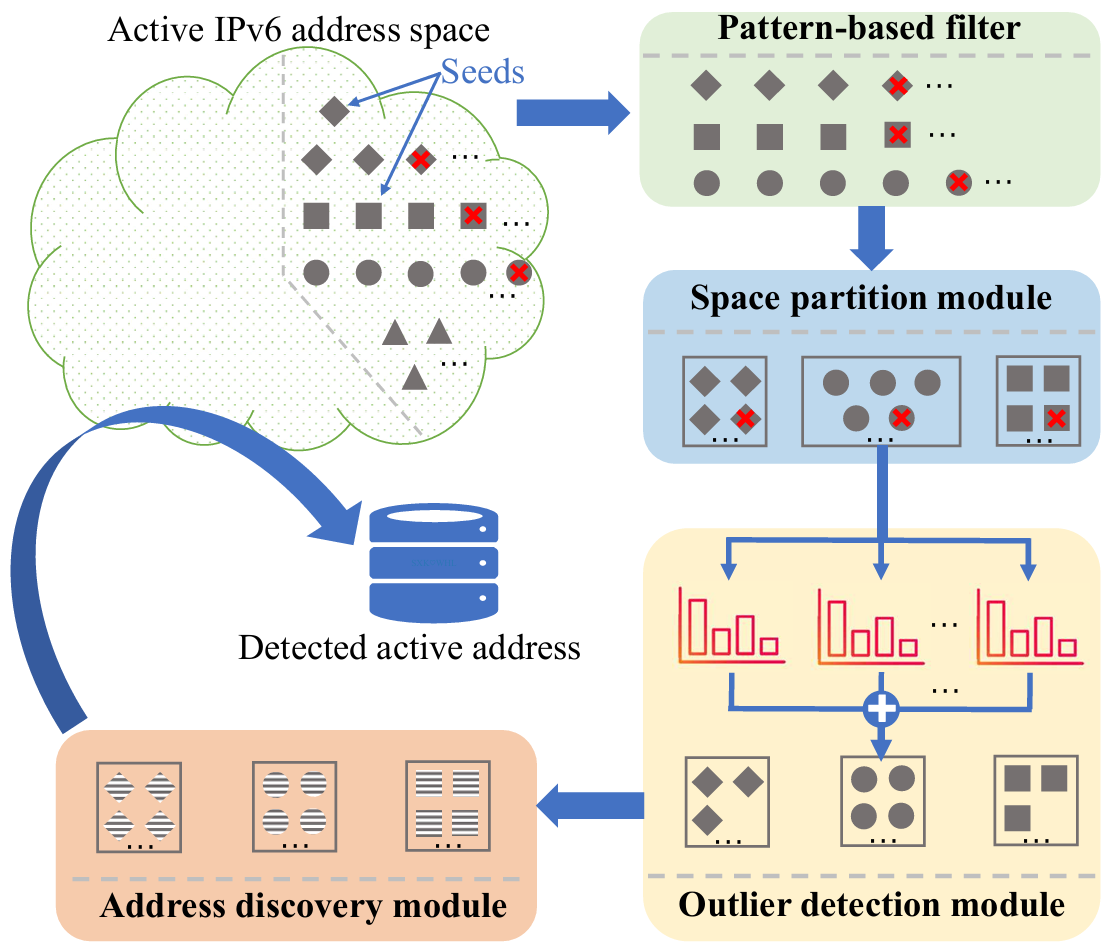
6Loda: Pattern Filtering and Ensemble Learning for IPv6 Target Generation and Scanning
Xikai Sun, Fan Dang, Zihao Yang, Xinqi Jin, Junhao Li, Yunhao Liu INFOCOM, 2025 [CCF A] project page / conference paper / bibtex Abstract: IPv6 target generation is crucial for surveying the vast IPv6 address space, which is essential for network management and IPv6 deployment policies. However, existing techniques often suffer from low hit rates due to ineffective space partitioning caused by outlier addresses and limitations in current outlier removal algorithms. To address these challenges, we propose 6Loda, a novel approach that combines pattern filtering and ensemble learning to efficiently remove outlier addresses and discover active IPv6 addresses. Given a set of known active addresses, 6Loda first employs a pattern-based filter to preliminarily eliminate some outlier addresses. It then utilizes a two-level (divisive hierarchical clustering) DHC algorithm to partition the seed set and applies the Loda algorithm to automatically remove remaining outliers in address spaces. Finally, 6Loda implements the random generation algorithm to produce addresses with high hit rates. Experiments conducted on large-scale datasets demonstrate that 6Loda achieves a × 2.26 improvement in hit rate compared to state-of-the-art methods, while maintaining the same budget constraints. |
|
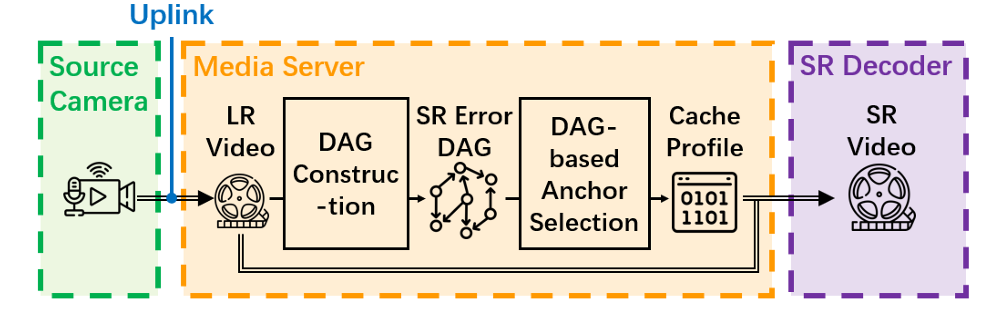
Palantir: Towards Efficient Super Resolution for Ultra-high-definition Live Streaming
Xinqi Jin, Zhui Zhu, Xikai Sun, Fan Dang, Jiangchuan Liu, Jingao Xu, Kebin Liu, Xinlei Chen, Yunhao Liu MMsys, 2025 conference paper / bibtex Abstract: Neural enhancement through super-resolution (SR) deep neural networks (DNNs) opens up new possibilities for ultra-high-definition (UHD) live streaming. Yet, the heavy SR DNN inference overhead leads to severe deployment challenges. To reduce the overhead, existing systems propose to apply DNN-based SR only on carefully selected anchor frames while upscaling non-anchor frames via the lightweight reusing-based SR approach. However, frame-level scheduling is coarse-grained and fails to deliver optimal efficiency. In this work, we propose Palantír, the first neural-enhanced UHD live streaming system with fine-grained patch-level scheduling. At the core of Palantír is its SR video quality estimation strategy which guides the low-delay selection of the most beneficial anchor patches. Although existing systems propose estimation strategies for anchor frame selection, these strategies heavily rely on empirical insights that cannot be transferred to our context, making fine-grained scheduling a challenging problem that requires a fundamentally new solution. Facing the challenge, we follow the first-principles approach and derive a directed acyclic graph (DAG) model to address the problem. The model can also be generalized to various settings due to its first-principles nature. Compared to the state-of-the-art real-time frame-level scheduling strategy for live streaming, Palantír reduces the anchor size by 80.1% at most and 38.4% on average without compromising the quality gain. Furthermore, Palantír incurs a scheduling latency accounting for only 0.6-3.9% of the end-to-end latency requirement for UHD live streaming. |
|
An Anonymous Authentication Scheme Based on Blind Signatures for the FIDO Protocol
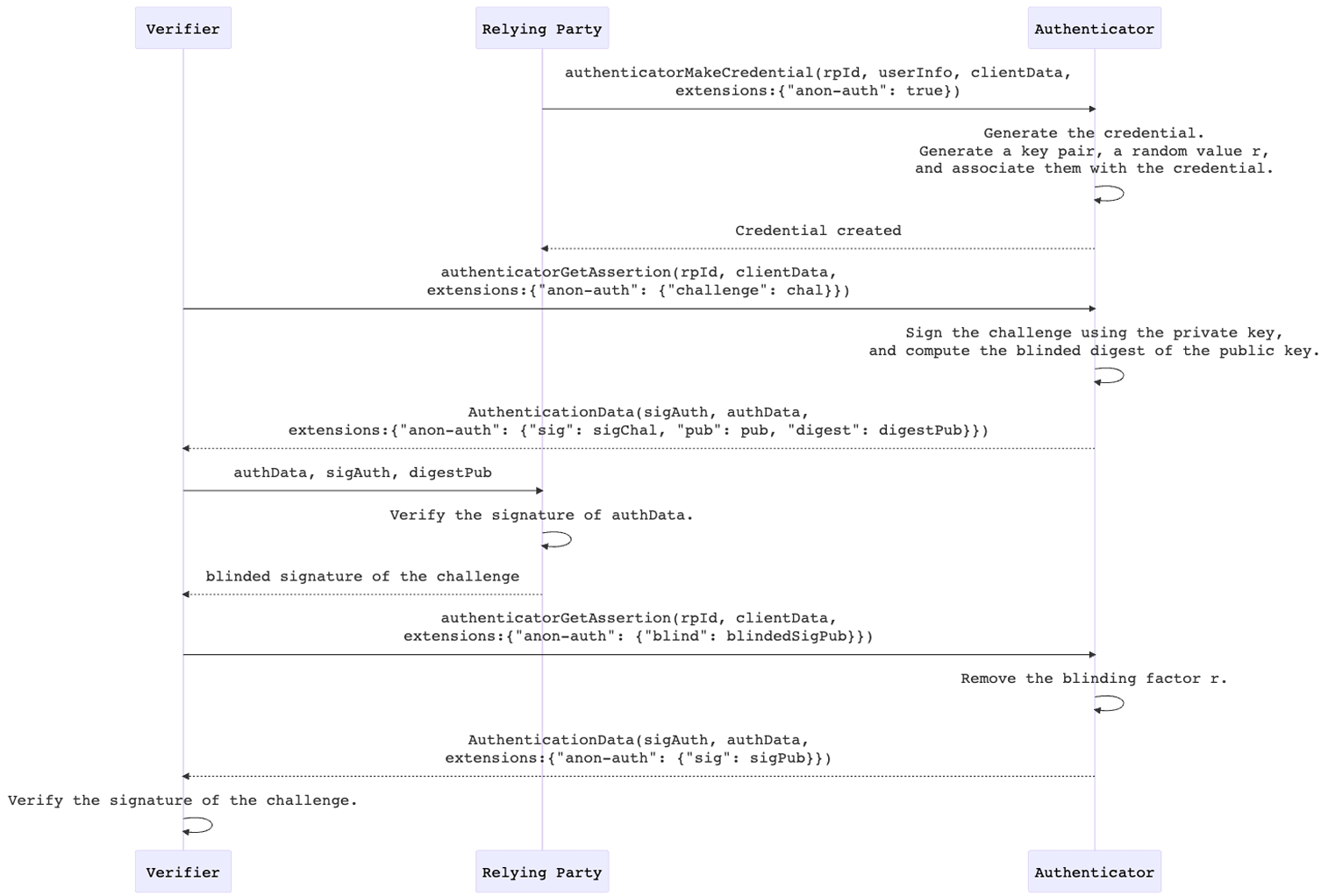
Fan Dang, Xikai Sun(Student-first), Kebin Liu, Xuan Ding, Xu Wang, Yunhao Liu MoNeTeC, 2025 conference paper / bibtex Abstract: The Fast Identity Online (FIDO) authentication protocol, the latest iteration of the FIDO2 standard, aims to provide a more secure and user-friendly online authentication method. In the era of digital transformation, anonymity has become a critical aspect of digital security. This paper proposes a novel anonymous authentication extension for FIDO based on blind signatures, enabling users to obtain signatures on public keys without revealing their content to the relying party. The proposed scheme is evaluated in detail, demonstrating its feasibility and effectiveness. By addressing a significant gap in current authentication methods and enhancing user privacy, this research contributes to the advancement of secure and anonymous online authentication techniques. |
|
Fingerble: A device fingerprint identification scheme for ble devices
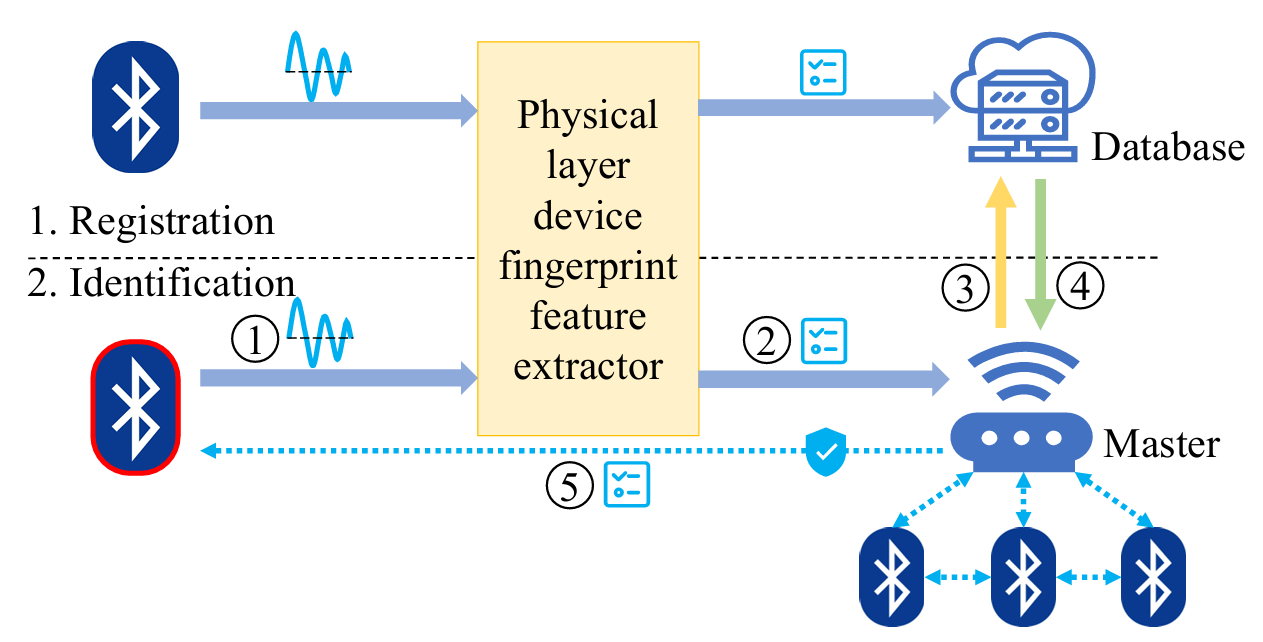
Xikai Sun, Fan Dang ICPADS, 2023 [CCF C] conference paper / bibtex Abstract: With the increasing popularity of industrial networks, driven by the development of the Internet of Things, cloud computing, and big data, there are still security threats when it comes to using wireless communication technologies, including BLE, in these networks. This is primarily due to the heterogeneity and resource limitations of the devices. To address the issues of device cloning and enhance BLE device access authentication, a device authentication mechanism based on physical features can be employed. By leveraging the uniqueness and nonreplicability of physical attributes, such as fingerprints, this mechanism effectively mitigates attacks. Therefore, this paper proposes a BLE device authentication scheme called FingerBLE, which relies on the physical fingerprints of devices at the physical-layer. In terms of system design, this article also introduces a fingerprint database authentication mechanism that utilizes the aforementioned fingerprints for node recognition and legitimacy authentication. Experimental results demonstrate that FingerBLE is capable of successfully extracting corresponding device fingerprints and accurately identifying nodes across a wide range of tests. |
|
TSTSS: A Time-Sensitive Task Scheduling System for Multi-modal Industrial Internet of Things
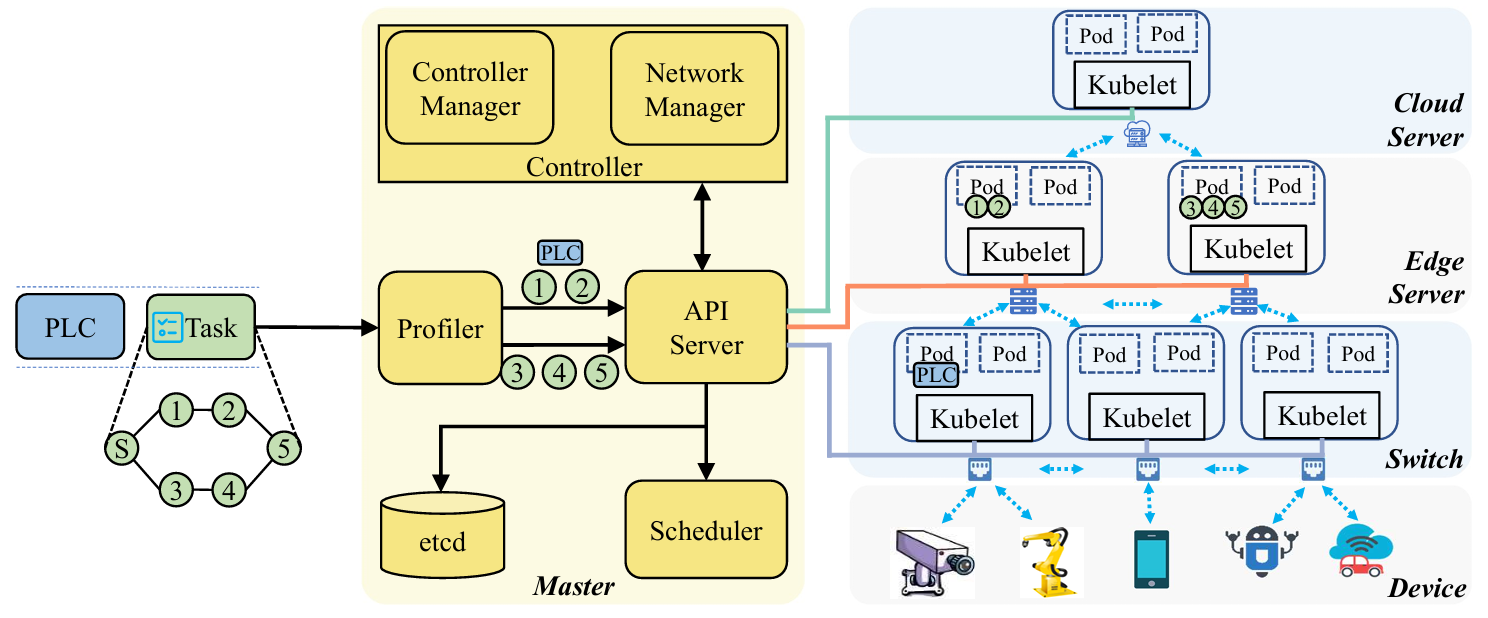
Xikai Sun, Xu Wang, Fan Dang TURC, 2023 poster paper / bibtex Abstract: We propose a task scheduling system for Multi-modal Industrial Internet of Things (IIoT). The system is based on the improvement of Kubernetes and the parsing of task. Furthermore, it can dynamically select the appropriate nodes to parallelly process sub-tasks according to theirs latency requirement and real-time communication and computing conditions. It can effectively solve the impact of latency sensitivity differences on task scheduling in IIoT. |
|
A survey on clock synchronization in the industrial internet
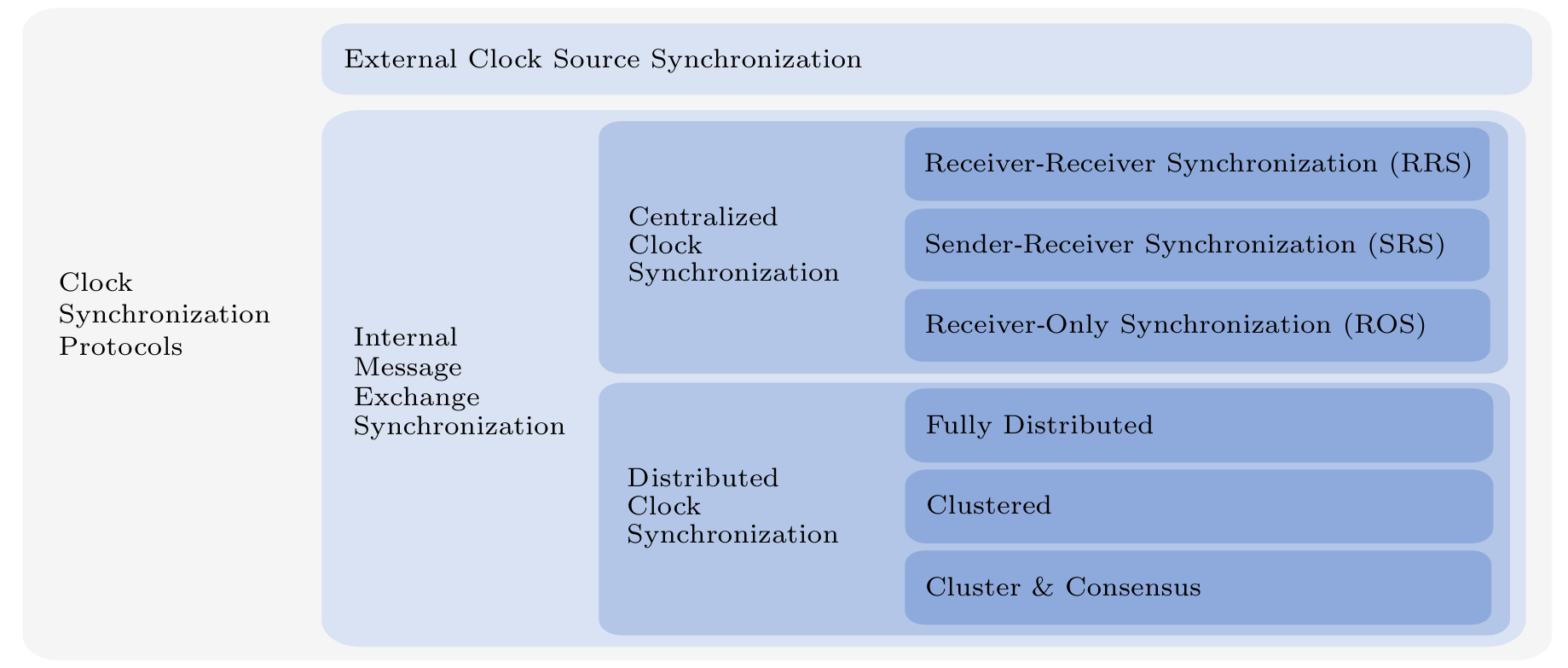
Fan Dang*, Xikai Sun*(Co-first), Kebin Liu, Yifan Xu, Yunhao Liu JCST, 2023 [CCF B] journal paper / bibtex Abstract: Clock synchronization is one of the most fundamental and crucial network communication strategies. With the expansion of the Industrial Internet in numerous industrial applications, a new requirement for the precision, security, complexity, and other features of the clock synchronization mechanism has emerged in various industrial situations. This paper presents a study of standardized clock synchronization protocols and techniques for various types of networks, and a discussion of how these protocols and techniques might be classified. Following that is a description of how certain clock synchronization protocols and technologies, such as PROFINET, Time-Sensitive Networking (TSN), and other well-known industrial networking protocols, can be applied in a number of industrial situations. This study also investigates the possible future development of clock synchronization techniques and technologies. |
Miscellanea |
Teaching |
Teaching assistant of AIOT, GIX, Tsinghua University, Autumn 2023 |
|
The source code of this website comes from the template jonbarron.github.io, thanks to the author's contribution. |